Home appliances is a highly competitive market: dozens of brands with comparable ranges, and a purchase decision that is rarely formed in a single ad contact.
Midea needed more than quality site visits — it needed users with a real interest in the category, brought all the way to specific target actions.
In June 2026 Method Media, together with the programmatic platform MediaSniper, launched an Midea campaign using Platforma data. The strategy was built on behavioural patterns and transactional activity, their clustering, and the subsequent scaling of the most effective audiences with Look-alike.
The task: users with a need, not just an interest
For home appliances, interest in the category is not enough. A user may read reviews, look into repairs or browse marketplaces without planning a purchase any time soon.
The team had to identify the audience at different stages of need formation more precisely and focus ad contacts on the most relevant users.
The strategy had to work with existing demand and, at the same time, find users who are not searching for appliances yet but already show behaviour that signals a potential need.
The KPIs covered both media metrics and post-click traffic quality. An additional goal was growth in direct post-click conversions — first of all, add-to-cart events.
The solution: from broad targeting to behavioural signals
The team used three instruments: Platforma data, Look-alike models and contextual targeting.
How the campaign worked
The campaign was not built around one large segment but around consistent work with many audience slices.
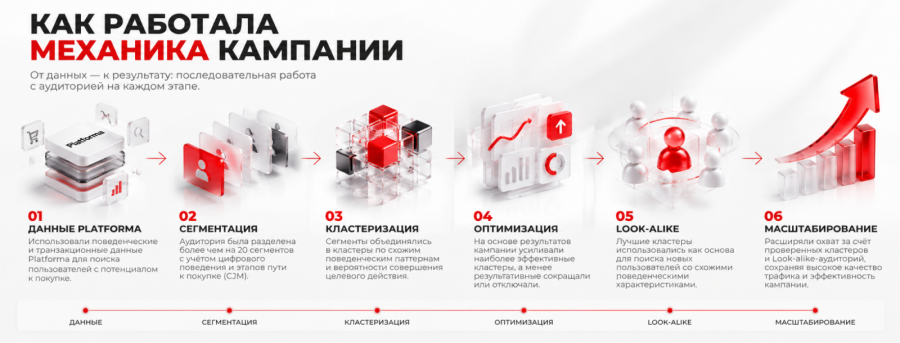
First, Platforma data was used to split the audience into more than 20 segments, later grouped into clusters. The next step was testing cluster performance: the system showed which user groups responded to ads better and performed target actions more often.
The strongest clusters were amplified, weaker ones were cut or switched off. As the campaign ran, budget shifted towards audiences with a higher probability of a target action.
Data → segmentation → clustering → optimisation → Look-alike → scaling.
Results: traffic quality and post-click conversions
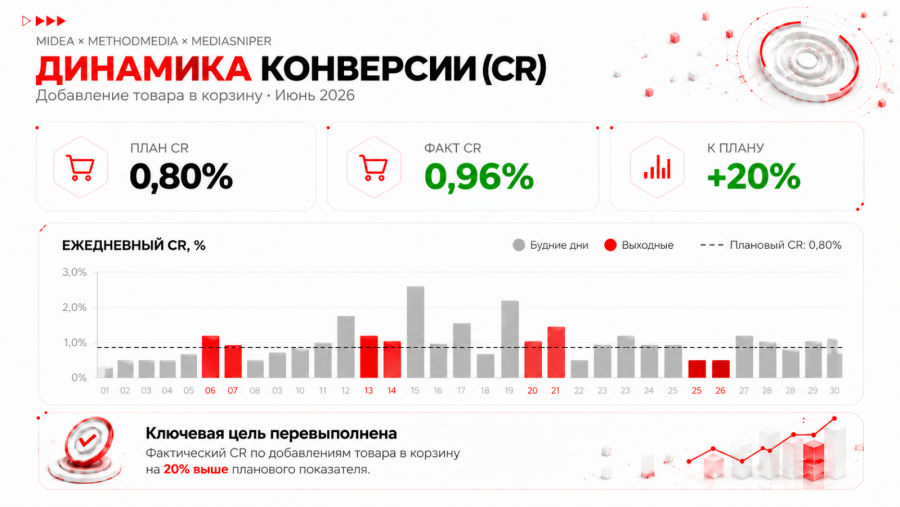
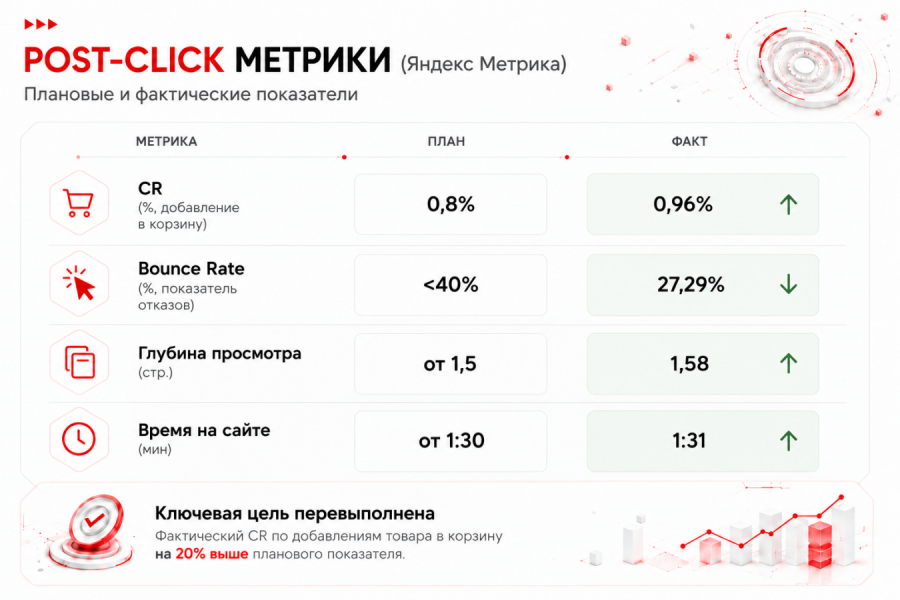
The results confirmed the effectiveness of the audience strategy: with an add-to-cart KPI of 0.8%, the actual CR reached 0.96%.
The traffic met the quality targets: bounce rate 27.29% against a KPI below 40%, 1.58 pages per visit against a target from 1.5, and 1 minute 31 seconds on site against a benchmark from 1.5 minutes.
What mattered most was obtaining direct post-click conversions. Programmatic usually works at the upper and middle stages of the funnel — reach, interest, site visits. Here the combination of behavioural data, clustering and Look-alike brought media placements close to a performance task.
Programmatic is therefore no longer just a tool for attracting attention, but a part of the performance funnel where audience quality can be measured down to a specific user action.
What the team says
“What stands out in this case is that work with the audience did not stop at attracting quality traffic. Deeper work with behavioural data helped find users who were not merely interested in the category but ready to take a specific action on the site. Add-to-cart CR reached 0.96% against a 0.8% KPI. It shows how important it is not only to assemble a relevant audience at the start, but to keep analysing the performance of individual segments and shift budget towards those that actually convert.”
“It matters to us that programmatic solves more than image tasks and brings users to a specific action. In home appliances the decision is rarely made after one contact and the customer journey is complex, so standard targeting on general category interest is not enough. Behavioural data let us define the audience with an actual need more precisely and build communication around the stage of choice.”
“Buying large home appliances takes time, so it mattered to catch the moment a real need appears. Together with MediaSniper and Midea we built a multi-level model of audience work — from uncovering hidden interest scenarios to scaling the most converting clusters. In its first month the campaign showed post-click traffic quality well above market benchmarks.”
bld. 7, str. 9, BC "Novospassky"
© 2020–2026 Method Media